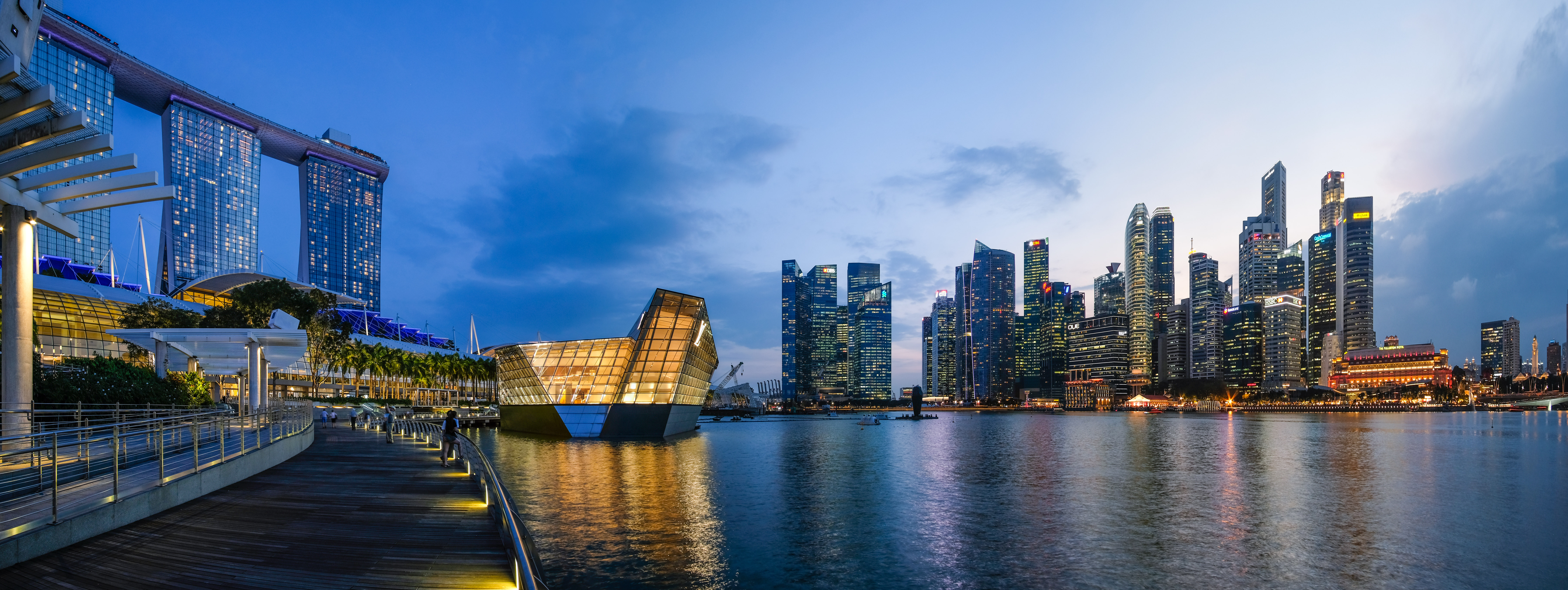
In a city where air conditioning accounts for an estimated 40–60% of total building energy consumption, the idea of centralising cooling production in a single plant and distributing chilled water through underground pipes has significant economic and environmental logic. Singapore now operates several district cooling systems (DCS), with the Marina Bay network being the largest and most documented.
How District Cooling Works
A district cooling system replaces individual building chillers with a centralised facility that produces chilled water at around 4–6°C. This water is pumped through insulated underground pipes to connected buildings, where it absorbs heat from the building's internal air-handling units. The warmed water returns to the central plant for re-cooling.
The efficiency gains come from three factors:
- Scale: Large industrial chillers operate at higher coefficient of performance (COP) values than smaller building-level units. A DCS plant typically achieves COP values of 5.5–6.5, compared to 3.5–4.5 for individual building systems.
- Load diversity: Not all buildings in a district reach peak cooling demand simultaneously. A centralised system sizes its capacity based on the aggregate peak, which is lower than the sum of individual peaks. This reduces total installed chiller capacity by 15–25%.
- Thermal storage: Many DCS plants include chilled water or ice storage tanks that allow cooling production during off-peak electricity hours (typically nighttime) for use during daytime peaks.
Marina Bay District Cooling System
The Marina Bay DCS, operated by SP Group, is one of the largest in Southeast Asia. The underground plant serves more than 20 commercial buildings in the Marina Bay Financial Centre, including office towers, retail complexes, and the Marina Bay Sands integrated resort.
Key specifications:
- Total cooling capacity exceeding 150,000 refrigeration tonnes (RT)
- Chilled water distribution through a network spanning several kilometres of underground piping
- Thermal energy storage capacity equivalent to multiple hours of peak demand
- 30–40% energy savings compared to equivalent standalone building systems
For building owners connected to the network, the arrangement eliminates the need for rooftop cooling towers, reduces mechanical room floor space, and transfers equipment maintenance responsibility to the DCS operator. The freed-up roof and mechanical space can be repurposed for green infrastructure or additional usable area.
Expansion to New Towns: Tengah
Singapore's newest HDB town, Tengah, is being developed with a built-in district cooling network — a first for public housing in the country. The "Forest Town" concept integrates centralised cooling with car-free ground-level design and extensive tree canopy coverage.
The Tengah DCS will serve approximately 42,000 residential units across five housing districts. Unlike Marina Bay's commercial-focused system, Tengah's network must handle the distinct load profile of residential buildings: lower daytime demand and higher evening/nighttime peaks. The system design includes dedicated thermal storage to smooth out these variations.
Environmental and Urban Heat Implications
Centralised cooling has a secondary benefit that is often overlooked: it removes heat rejection equipment from individual buildings. Conventional air conditioning systems reject absorbed heat through rooftop condensers, which raise the temperature of the surrounding air — contributing directly to the urban heat island effect.
A district cooling plant consolidates heat rejection in a single location, where it can be managed more efficiently. Some advanced systems use seawater or underground aquifers as heat sinks, further reducing the thermal load released into the urban atmosphere.
According to modelling conducted under the Cooling Singapore 2.0 project, widespread adoption of district cooling combined with improved building envelope performance and expanded urban vegetation could reduce Singapore's peak urban heat island intensity by 2–3°C by 2050.
Changi Business Park DCS
A secondary DCS at Changi Business Park serves the concentrated cluster of technology and aviation industry offices near Changi Airport. This system was designed to handle the specific cooling demands of data-intensive operations, where server heat loads add significantly to standard commercial building requirements.
Related: Reflective coatings for building exteriors | Green roofs and vertical greenery systems
References
- SP Group District Cooling — spgroup.com.sg
- Cooling Singapore 2.0, Singapore-ETH Centre — sec.ethz.ch
- HDB Tengah Town Planning — hdb.gov.sg
- BCA Zero Energy Building Reference — bca.gov.sg